
A Girl called Mary Wangari
WORLD STORIES
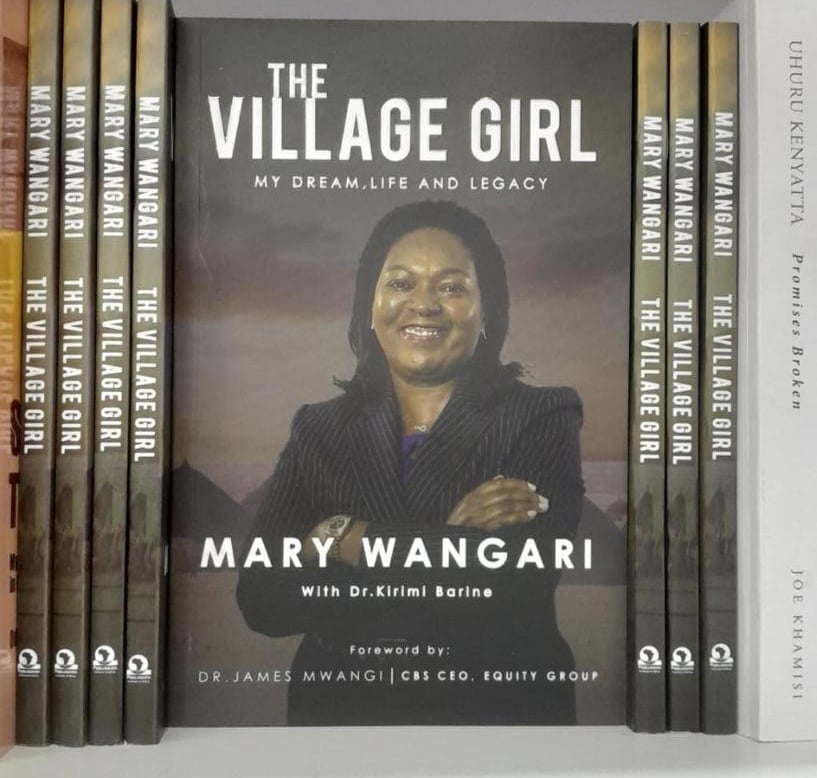
Recently, I stumbled upon a little black book by one Mary Wangari, titled “A Village Girl." As I started reading it, I realized it was by an author I should have known as she is a leading figure in Kenya's banking sector, a familiar territory for me.
Once I pick an interesting book, I feel compelled to quicly read it to the end. That's how I finished this little book overnight; it's just 111 pages. Amazing! How could I have overlooked a prominent figure at a bank that I’ve been keeping on my radar since it was founded by my neighbour, Peter Munga, in 1984. Its well-known CEO, Dr. James Mwangi of Equity Group, was someone I used to call a "classmate" — our private code name for my students during my time at the University of Nairobi. I used to lecture there where I learnt, as a lecturer, that you cannot teach students anything directly; you can only help them discover what their Creator has placed in their brain.
This villager Mary Wangari was born on 7th July 1968 well after the end of that horrible period. period, now an infamous day in Kenya but for different reasons. She even wishes that the same “village” concept could be applied to re-define Kenyan rural life today. She believes it could promote the development of rural towns, similar to what I have observed in a part of modern-day Germany called Duderstadt. Such an approach could also help increase our rapidly diminishing arable land, particularly in Kisii land that is going through excessive land subdivision.
Advert #1


After a challenging start to her career after graduation with an upper second-class honours degree, she struggled to establish her own legal firm in Nairobi's rapidly expanding CBD. This was when James Mwangi, the then Managing Director of Equity Bank, visited her office and offered her a chance to serve as the lawyer for a financial deal worth millions of dollars. Overwhelmed by the opportunity, she decided to accept the challenge. Although lacking experience in large financial transactions, she knew she had to find a way to succeed and secure the deal for Equity.


Advert #2
As the saying goes, that was her turning point. She transitioned from being a lawyer to a banker, ultimately climbing the ladder to become the CEO of Equity Bank, which is now the largest bank in Kenya with a capitalization of KSh. 146 billion (US $1.2 billion). The bank has expanded throughout Central Africa, reaching what can be described as a veritable goldmine called the Democratic Republic of Congo (DRC).
This success is attributed to having a truly visionary banker and team leader who served as the Chairman of President Mwai Kibaki’s “Vision 2030 Project.” This serves as a challenge to our youth with degrees: if you knew that James Mwangi also started as a “village boy” in Nyagatugu in Murang’a County and became the Bill Gates of Kenya, you might reconsider looking abroad for employment when job opportunities are emerging in your own country, which is increasingly being targeted by foreign investors like the controversial Gautam Adani.


Advert #3
If you need convincing, simply go to the roof of the Kenyatta International Convention Centre (KICC) and take a look at Nairobi’s skyline, which is still expanding upward. Alternatively, visit the iconic UAP (Old Mutual) Tower in Upper Hill, a building constructed by the legendary late JB Wanjui, who was also the landlord of Equity Holdings in the same area.
Thank you, Mary Wangari, for writing such a short yet amazing little book. I will find a way to make your book join the ranks of successful titles like “Rich Dad Poor Dad” and others.
If a poor village girl from Tetu, Nyeri born to a single mother, can achieve so much, what’s stopping you girls and boys from discovering your true value? You can accomplish this after reading this remarkable book titled “A Village Girl.” Interestingly, her birthplace is the same as that of the late Professor Wangari Maathai, Kenya’s only Nobel Prize winner. They share more similarities than Mary Wangari, the banker, may even realize. Perhaps, she could consider Maathai as a role model.
I could be wrong.
JH Kimura, PhD
(A village boy.)

In case you want to buy this book it is available in both hard and soft copies. It can also be delivered to a designated place by rider or by post, to a designated pick-up point.