
A Taste of Honey
THE ROAD TAKEN

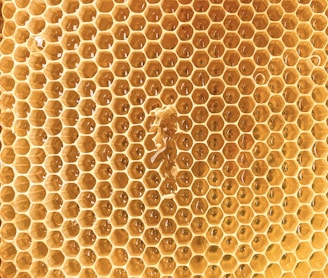
When they first became aware that they had been living together for a long time, none of the several thousand bees that lived in the hole at the front of the big tree could remember how they had come to be there.
They just found themselves in a group, perhaps for comfort, perhaps for companionship: None was sure.
In spite of their crude home, they were happy and did not have very many worries except for the shortage of nectar in the time of drought and wetting of wings in the rain. But it was as monotonous as life could be. Day in, day out they were mostly busy; taking care of the young, feeding the Queen, collecting nectar, making honey, resting now and then; and dying of the same endless monotony experienced by generations before them.
Into this happy society of nature, there came a strange bee who had apparently missed the way to his own home. The occupants of the hole were suspicious of him but as he had brought his own nectar with him they tolerated him and said he could stay if he was prepared to work. “No objection”, said the strange bee, “I have been a worker all my life”. But the strange bee was discontented with the sort of life he was forced to lead.
However, he realised there would be gain in staying if he per- severed and he soon made many friends and a name for him- self. For he was quite intelligent compared with the riffraff he had found in the hole and within a day he had devised a new system of feeding the young bees. Another day, he secretly started a new brood using a different type of nectar. On the third day, with all the muses on his side, he came up with the idea that the Queen was old fashioned and that they needed a new one.
So in the evening, he personally poisoned the Queen
She was dead within five minutes and none in the hole ap- peared sorrier than he. So to expiate for his sins or perhaps to curb all suspicion, he suggested that they have an hour of mourning for the “poor old Queen, who was such a dear, tru- ly beloved and respected by us all”. So she was buried in a corner of the hole and mourned and missed.
The same night, a new Queen and her brood of drones were hatched and throughout the night hundreds of workers were born so that by morning there were enough new bees to form a colony of their own. The new breed was definitely a cut above the rest for they had been specially fed using a type of honey that not only accelerated the rate of growth but also concentrated in one area the intelligence scattered around their little brains. No sooner was the new generation born than they all started grumbling about the crudeness of their home. The Queen complained more than everybody else and instantly issued a decree that a new home had to be procured before nightfall, no matter the cost.
For the rest of the day, every bee in that hole was busy, even the drones were thrown out by the Queen herself, telling them that they were dull old things who did nothing except sit and dream and drone all day as if they were going to live forever. Great discoveries are occasionally made by unknown persons and it was a little bee, hitherto obscure, who said that there was a great hole in the tree below which they lived and he was sure was as good as any in the Universe. It was investi- gated and found to be at least more habitable than the other one. So amid jubilation, they moved from their old home tree to the Great Hole in the tree and carried with them enough honey to keep them going for some time.
The bee who started the whole train of events was ageing quickly, although he was only six days old. That is quite a long time for a bee. But he still wanted one more thing done and then he would consider himself successful. So he went out one day and came back with three or four bees who knew how to modify holes in trees into more comfortable places for living. It did not take a long time to convince the Queen that the new fellows were the most obedient she had ever seen and that they were the best carpenters for the job in hand.
The Queen was pleased. The carpenters got to work promis- ing to go away as soon as the job was completed. They had a large number of helpers. Sadly, just before the job was over, the pioneering bee died peacefully in his sleep. He was nei- ther mourned nor missed. The expatriates finished their job but did not go away. They said there was no point and fur- thermore their services were likely to be needed in the near future. So they stayed and created a carpenter class of bees.
It so happened that when the old home was evacuated there were a few fairly conservative and rather obdurate bees of the old order who had refused to go. They argued that it was greatly unfair to forsake their original home because a little lout of a bee had said it was no good. So they stayed in the old home and although they faced some difficulty, they man- aged to keep a faintly flickering flame of a forgone age. They fed the Queen on their own and somehow kept on living.
It is a generally accepted principle, even among bees, that once you realize that you can do one thing, then you aspire to do greater things. So as the community of the Great Hole thrived and generally enjoyed a state of prosperity, the Queen started complaining- this time that the air was rather close and the Great Hole was getting stuffy. “Why”, she asked “can’t some of you fellows find a better place”. So once again she sent out scouts and spies to adjacent lands strictly warning them that if they returned without finding the kind of home she wanted, they would be executed imme- diately.
Far and wide, they searched in vain, but rather than return to certain death, they chose to die in the wilderness. Nobody would miss them. But one afternoon, Twado, a little bee with a scientific mind, was stretching his wings not far from the Great Hole when suddenly he found himself in what he termed “a great cylindrical cavern in the air which”, he add- ed, “ is absolutely free from interference by outsiders and is absolutely secure”.
No sooner had he made this tremendous discovery than he rushed back to the Queen and in fits, started to describe what he had found. “It is just up here. Very near indeed”. In a flur- ry everybody rushed out to see the thing which was no other than a cylindrical hive. The Queen took possession of the fabulous home the moment she got there. Evacuate! Evacu- ate! She shouted to her community and once more, they moved to the hive and within a day comfortably settled them- selves therein.
Now as the case in such situations, people do not always see eye to eye. Neither did these bees. Once again, there were some who preferred living in the closed Great Hole to living in “a floating home”, for that is what the hive suspended by a cord from a bough of the tree looked like. These were mostly the carpenters and their adherents who knew their services were no longer required. They had known trouble was com- ing and had managed to hide a considerable quantity of honey in a corner of the Great Hole “just in case”. These had a much more secure start than the primitive mob at the foot of the tree. So with their supplies of misappropriated honey, they quickly established a large society hatching several thousand new bees every day. They argued that in spite of their tremen- dously increasing numbers, they had the means to save and hence the means never to suffer from the ravages of the famine.
As for the Queen and her followers, they found the hive even more fabulous than they had hoped it would be. Perfect venti- lation, a large number of small doors aptly situated at either end, security; above all there was civilization! The tragic part of the story was that little Twado was never remembered for this though he was given a dose of royal jelly just after they moved in. And when he died, nobody knew about it. In fact, he died under a petal, one morning of a heart attack. He had become very bitter about the way they ignored and treated him like dirt and wished he could do something about it. But his head could think of nothing; it did not have very much brain within.
While the new state prospered and the bees within had be- come the happiest ever known there came a strange and alto- gether an unexpected turn of events. It started with a little stuffiness that gradually increased until the whole hive was a foggy mass of steam and smoke and roasting babies. There was absolute chaos and confusion and the bees started scur- rying about helter-skelter, stamping, biting, stinging, cursing, mumbling, screaming and murdering. They stumbled out of the hive and a lot of them were burnt alive; others lost their wings; their legs or other essential parts of their body. Those that did escape flew back to the Great Hole- where they were welcomed and given little food for there wasn’t much to spare anyway- and others flew to the hole at the foot of the tree where quite a few were murdered and those that were lucky were mistreated and teased by the old fellows who wanted “to get a bit of their own back”. Others flew off into the night and nobody ever heard of them again.
The cause of all this confusion was the owner of the hive who had come to collect his honey. It did not occur to him that this might hurt the bees. When he had collected all he wanted and had thrown away what he didn’t, he set out for home; humming contentedly.
A silent observer to this strange spectacle was a jackal who thought it most amusing and as soon as the man was out of sight, he laughed uproariously at the joke. For you see, Jackal had a great sense of humour. Then he turned and went away.
Many days later, he never was good at figures, Jackal was passing through the forest when he saw a man doing a similar operation. This time he was genuinely interested and when the man had gone away, he went to investigate. There was some yellow stuff scattered all over the ground. He smelled it...Not bad...Nibbled...Not bad...Had a mouthful... Delicious...but there was a little stinging...but at any rate it was a good dinner even if they stung...well, it didn’t hurt much. He rolled on the soil and realised that where there was dirt, it didn’t hurt much. Only his snout.
“Most interesting”, Jackal murmured as he licked his lips. Then he went away smiling, contentedly like someone who knows his secret is secure.
Back at the hive, after the “Evening of Disaster” as the poets of the hive later called it, there was a general state of recon- struction during which the bees who lived at the foot of the tree swarmed up to the hive and declared that they were now the rightful owners. They had earned it, and in spite of possi- ble insecurity, they argued that disaster occurs only once in a lifetime, which God knows, is not very long for a bee. Even the ones at the Great Hole were forced to go up the hive and all the community became one.
Soon it came to be realised that it was becoming absolutely impossible to make the inhabitants of the three societies to live together harmoniously. There was discontent and malice behind every word spoken between virtually any pair of bees. There was a group that genuinely resented having to do obei- sance to the Queen from the hole “who was”, they said, “just a depraved bastard and a savage”. Her drones too they said, were primitive and barbarous. This soon got to the Queen and she was grieved that her subjects should say such things. So a commission of inquiry was set up consisting of four bees from the hole, two from the Great Hole and one from the re- maining occupants of the hive. They were given terms of ref- erence and swore to start work the following day.
The same evening Jackal was passing near the tree when he glanced up and saw the hive. “Well! Well! Well!” He thought, “This is the time”. He was feeling rather thirsty and as it was still fairly early, he decided to go and have a drink first from the nearby stream. He was thoughtfully lapping at the water when his foot slipped into the mud and when he pulled it off, it was muddy and wet. Then he had an idea. Without further delay, he jumped into the water then rolled onto the mud until he looked like the mud itself.
When he was satisfied that he was perfect, he walked up the hill to the tree...surveyed to ensure there were no unauthor- ized watchers...clambered the tree to the bough that support- ed the hive...landed on it carefully...tried one of the end co- vers...it opened...then there was chaos...chaos...stinging bees...buzzing...closed his eyes...put his snout into the sa- voury deliciousness that followed, forgot all about the bees and their stings...went on gobbling the stuff...the rope snapped!
Jackal did not know what happened; for a few seconds; he only experienced a strange weightlessness. The hive hit the ground and burst. The honey and the grubs were all over the ground. Then Jackal fled. The shock was too much for him. He died of heart failure before he had even got to the stream. Poor Jackal! He never could understand mechanics!
The commission of inquiry was forgotten in the current plight and the running away for dear life. Those that could, flew away but most perished from the stings from their fel- low bees and of the cold and rain that followed.
When the owner of the hive later saw what had happened and knew the cause of the trouble, he was very furious both at the bees and at Jackal. However, he collected the rem- nants of the hive and carried it home where he repaired it and set it up in a special place where he hoped, if any bees came, they would be safe from the ravages of the Jackal.
And while most of the bees scattered far and wide without any hope of reunion or even recovery, there were some who eventually found their way back to the humble but safe hole at the foot of the tree. They wanted to start afresh and they argued that it was better down there because the higher they climbed, the greater the fall.
East African Journal,
July 1968.