
Breaking the Glass Ceiling
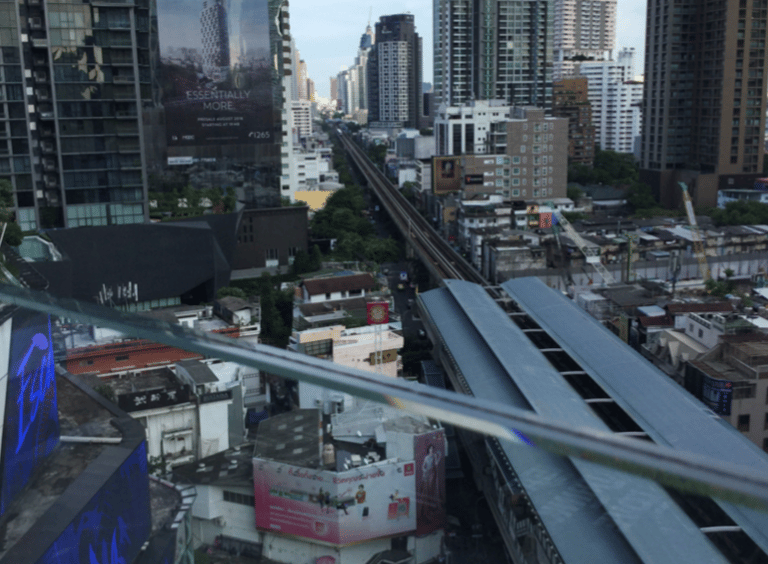
Sunrise in Bangkok
THE RESTLESS MINDTRM-R2
There is a Chinese saying: “A journey of a thousand miles starts with a single step”. Another one in my language says: “A man who never travels thinks that his mother is the best cook in the world”.
Background
Today, 30th September 2018, is a day when I woke up in Bangkok with many ideas crowding my head. It all started with an encounter with Kenya’s Ambassador to Thailand, Ba- lozi P. S. Wamoto. This was at the foyer of Bangkok Hospital where he suggested we meet instead of his office at the Kenya Embassy.
My Question
My question to the good ambassador was direct: Thailand, I had learnt, was a major exporter of agricultural produce mainly semi- and fully-processed. In fact, it was mentioned to me that the country, with an area of 513,000 sq. km (slightly smaller than Kenya), exports more food than the whole of Africa including South Africa. Whether it is true or not is not the issue here.
One thing I have become aware of: Despite their relatively small sizes, you never hear of mass famines in South-East Asia. The countries always grow enough food for their people and then export the surplus. It is reported that Thailand is the largest exporter of rice in the world.
The big question is: How do they do it and what can we, as Kenyans, learn from them? Is there a secret and, if so, can they let us in on it now that we have good diplomatic relations with them? Truth be told, Thailand does not even feature in the popular diplomatic map of Kenya and our people have no clue where its capital, Bangkok is, leave alone Thailand itself.
A Brief History of Thailand
According to Google, Thailand is quite an interesting country with a history going back many centuries. After emigrating from Southern China, the people gradually set- tled in its lush and well-watered countryside with numerous mountains, rivers and coastal plains.
After many fierce battles, the people evolved into a monarchy then known as Siam before the coming of the European colonizers led by the French and British.
There is a saying in African hunting mythology that if you want to know where the lion is having a feast, you do not ask the antelope. You look at the sky and watch where the vultures are circling high in the sky. Even the hyena knows it: “Hapo kuna kitu”.
And that is what had brought the colonisers to the far-east - literally their land of milk and honey in the form of silk, spices, exotic foods and other precious commodities like gold, elephant tusks, jewellery and fine clothing. The Chi- nese had, in fact, already established themselves as worthy trading leaders and had built their famous original “Silk Road”.
They could not be left alone to enjoy all those goodies alone, said the Western colonisers.
Fast Forward
Now that we have that information, why has it taken us Africans so long to realise that our salvation comes not from the West but from the lands of the rising sun? That is one of the greatest tragedies of our British colonisation.
As I seek the Balozi for answers, he confides that he has been trying to entice Kenyans to look east to see what they can learn but the response, especially from the counties, has been very poor. They seem hard-wired to think that answers can only come from the West or even from Israel.
That may explain why we have so many cruises and pilgrimages to the Mediterranean and Middle East which, from an economic point of view, have so much less to offer than from the countries of South-East Asia. Yet, it is manifestly obvious even to the casual observer that this is where we should be looking. Looks like our de-colonization has never sunk in. How many of us, for instance, can speak any of the languages of the East?
Where Do We Go From Here?
Now that you know, what are you and I going to do about it? This time, I will go straight to the point.
One, there is a great deal that we can learn from the agricul- tural practices of the Thai people. Especially the small-scale ones who reside on hillsides much more uninhabitable than ours. They have developed small-scale farming to an enviable standard. From the water-logged plains of Bundalangi and Ahero to the mountain slopes of Murang’a and Tharaka-Nithi, we can learn.
Even the perennially parched Ukambani and Tana River need not be so. All they have to do is to abandon historical misconceptions and biases and start looking, literally, for better ways than what they have always done traditionally. And it must start with that precious commodity called water - its conservation, management and utilisation
I am a great dissenter of the popular myth that Kenya is a “water deficient country”. The truth is: We just do not know how to conserve and manage our water resources. Period!
Second is proper soil management and improvements in crop husbandry. If we can regularly test our soils for their deficiencies or toxicities and get suitable supplements, we can go a long way towards resolving this problem. Our agricultural extension officers have been asleep for a long time. They must be woken up, re-trained or retired in the public interest.
The third is the agricultural value chain - each and every crop grown in the country can be partially “processed” or modified for the market. Elsewhere, I have referred to this as change of mentality to a different model: RTM - Route To Market - a paradigm shift.
Growing crops is NOT and must not be an end in itself; the harvest must eventually reach the consumer be they local, regional or international. And in suitable packaging, certification and edibility. And at the best prices that they can negotiate.
On all these matters, there is a great deal that we can learn from Thailand. Especially all those county governors who have not started looking for practical and economically viable solutions to their county problems. A few of them are already doing it. Others must follow suit - they owe it to their people and must show the way. It is not too late.
Let me end by quoting an American professor who converted to Eastern philosophy: “When you change the way you look at things, the things you look at change”. (Dr. Wayne Dyer, 1940-2017).
If Thailand can do it and, do it beautifully and profitably, so can we.
[Contributions and inputs from H.E. Ambassador P. S. Wamoto are gratefully acknowledged.]