
“The Last Journey to Pagak”
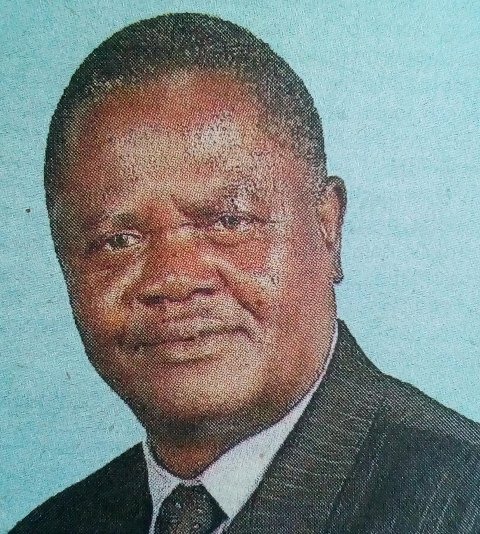
A Tribute to Chris Lukorito Wanjala

One of the most famous little books that I have ever read is Okot p’Bitek’s “Song of Lawino”. This rambling unorthodox poem was written by Okot in the inimitable Acholi story-telling tradition.
Okot, as we used to call him, was a human being first and foremost and then what I can only describe as a man after God’s own image as far as literary discourse is concerned. He loved his stylistics and did not care a damn what you thought about breaking every artificial literary boundary.
Before proceeding, I want to make a confession. When I met all those literary gurus between 1967 and 1970 - Okot, David Rubadiri, Ngugi wa Thiong’o, Taban lo Liyong, John Ruganda, etc. - I was not one of them. They, in fact, used to ask: what is this commerce stranger doing here? And I would calmly tell them I was just a lost soul, the prodigal son, seeking a way into the land of promise.
Golden Days of Literature
Those were the golden days of Literature in Kenya and it was housed right there in the Department of Literature in the Faculty of Arts. How such a high concentration of literary genius ended up in that one little department is a mystery that is yet to be explained.
And that is what attracted me, a Bachelor of Commerce student, among all those Anglo-wordsmiths.
And, by and by, that is how I came to learn more about the man behind the “Song of Lawino”. For reasons I still don’t understand to this day, three passages stuck in my mind about Lawino:
The Mortal combat;
The last journey to Pagak;
The pumpkin in the old homestead
Mortal Combat
The bit about the two warriors locked in mortal combat while the children are dying of starvation is a poignant reminder that our politicians - then and now - seem to have no clue about the challenges their electors are going through. To a fault, they were just focused on who among them, all metaphorical pygmies really, was the tallest of them.
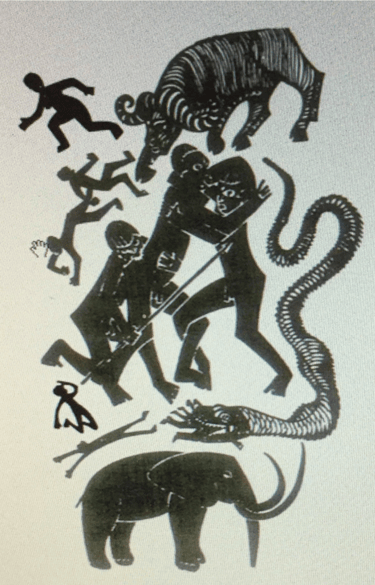

“The war leaders are tightly locked in bloody feuds...”
The Last Journey to Pagak
One of the most touching verses that I still remember from the “Song” is a bunch of stanzas talking about the “last journey to Pagak”. I have no clue where Pagak (South Sudan) is in Acholi culture but, quite clearly, it is in a place from which you never return, a one-way journey.
As he puts it:
But when the day has dawned
For the journey to Pagak
No one can stop you...
When Death comes
To fetch you
She comes unannounced,
She comes suddenly
Like the vomit of dogs..
Only those who have experienced the absolutely irresistible calling of those final days can appreciate the power of Okot’s allegory. For me, it came barely a week ago when, out of the blues, I had to call an old friend, Chris Wanjala, to consult him about a writer who had become hard to get: Meja Mwangi of “Down River Road” fame.
It turned out that my daughter Mwihaki had recently made it her business to find out about a whole bunch of Kenyans from all walks of life who were famous at one time or another but were slowly fading into oblivion. She had already written about a whole lot of them but when it came to Meja Mwangi, she had hit a blank wall: no one seemed to know exactly who he was.
And that is when she called me and I told him I had some vague recollections from the 70s, but as to his true identity, there was only one person I could rely upon: Chris Lukorito Wanjala as I used to call him. Chris and I had met at the university when I was making my escapades into the literary corridors across the Great Court from the Gandhi Wing.
Trip to Wandegeya
For some reason, we hit it off and I came to know him quite well - and a bunch of other budding student writers - Jared Angira-Roberts, Sam Kahiga, Kimani Gecau, Micere-Mugo, Gacheche Waruingi. Later, we were to share a few short stories and poems in two journals of the day – “The East African Journal” and “Busara”. Chris and Gacheche were the editors led by Leonard Kibera who was our senior.
And that is how, in 1969, we all ended up at Makerere University College in Kampala at a writer’s workshop organized by those big names of the day. It was a remarkable visit for me as it was my first trip out of my motherland. We had our good times around Wandegeya, made famous by bats in the Eucalyptus trees, and we even went out on a boat ride on Lake Victoria – a truly remarkable outing for a rural upcountry boy from Ndakaini.
Unfortunately, our blooming relationship got interrupted when we graduated and went our separate ways – him, back to Uni and I went out into the commercial world which I had been programmed for. We were, however, to meet again a few years later when I joined the University of Nairobi as a tutorial fellow in commerce. A welcome-home- again moment.
Enter the Dowry Consultant
My most recent contact with him was in fact about two months ago when he called me with a delicate problem. His son had, as we say in my language, “broken the leg” of someone’s daughter and he, being a man of honour, did not want the matter to go on that way much longer. And that is why he called me to seek guidance on how to proceed. But we had to find out first who the father of the boy was and how he was going to be appeased.
Luckily for him, I sort of knew about the guy but, not being sure whether he was from “Gaki” or “Ndia”, (today’s Nyeri and Kirinyaga counties, respectively), I had to make few discreet enquiries... As they say in her majesty’s language, “All is well that ends well”. The necessary visit was made and, it appeared, all went well.
So, when I called him last Friday to check about Meja Mwangi, he happily agreed that we could meet in Nairobi “on Monday or Tuesday next week” as he was still out in Kakamega. I had hoped to ask him about the way the little affair of the “ruracio” went. He even invited me to come back “home” – to the literary world – where he believed I truly belonged.
So you can imagine my utter shock when my wife started asking me some questions at breakfast on Monday morning about “Wanjala of literature” as she used to call him.
The Pumpkin in the Old Homestead
One of our favourite jokes was about Okot’s reminder in the “Song of Lawino” that “you must never uproot the pumpkin in the old homestead”. Reason? As the family moves from one homestead to another in pursuit of better pastures, you never uproot the pumpkin plant for two reasons. One, so that as the prodigal son returns home, that may be the only way he can be sure that that was indeed his old home. And two, he might be hungry and the plant could provide a suitable something to cook and eat.
Chris, you clearly obeyed when “Mother Death” came for you to go with her to Pagak:
But when death comes
To fetch you
You do not resist,
You must not resist,
You cannot resist!
Fare thee well my brother. And, no matter what, keep on smiling as you always did. As for me, I must come and look for that pumpkin in the old homestead. Some day....
JH Kimura,
Nairobi.
18th October 2018
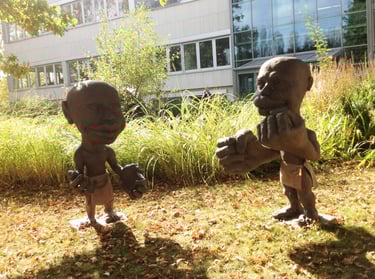
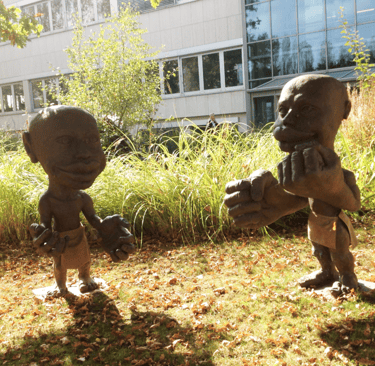
Reminds me of two statuettes I saw a few years ago in a small town in Germany called Duderstadt. In the garden of a facility I was visiting were two bronze castings of two Pygmies trying to figure out who was the better boxer between them.
“Pygmies of Duderstadt”