
The Road From Kisumu to Bomet
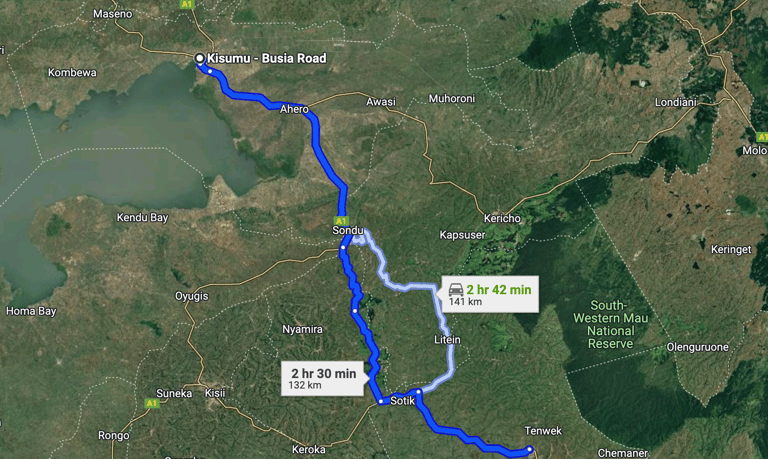
As I travel by road from Kisumu to Bomet and back, I cannot help but feel how tragic our development record is in this area.
My first travel on this road was way back in 1983 when I took a round trip with my family on the circuit Nairobi-Nakuru-Eldoret-Kakamega- Kisumu-Kericho-Nairobi.
Those were the days when one could take a leisurely tour just to see how we were doing on the development front. I had just returned to Kenya (in 1979) after a four-year stint in California and I wanted to get a real feel for how we compared with that part of the USA.
The Trip
Our first stop was Nakuru which was only 200km from Nairobi. We spent the night at the most famous colonial hotel in the place. Not very impressive, but we survived the night for the long trip the following day to Eldoret.
The newly opened Sirikwa Hotel was the place to be in and we checked into our private suite. Quite a nice place but, I noticed that there was a clear dominance by certain people who were trying to make a statement about “whose” hotel it was. Eldoret was then still a sleepy little town beginning to wake up from its colonial label of “64” as it was then known by the white colonialists and their Boer friends.
My daughter, then almost 10, was amazed at the splendour of the hotel especially the swimming pool where she spent a good deal of our time splashing around in the new swimming pool.
From Eldoret, we headed south to visit the famous Mumias Sugar Factory and the endless sugarcane plantations. After lunch at the club, courtesy of the then chairman Prof George Saitoti, we headed out to Kakamega Golf Club for the night. This was a newly constructed facility financed by the Kenya Tourist Development Corporation(KTDC). There was not much in the area of touristic interest.
Our next stop was the Sunset Hotel, Kisumu, another KTDC financed facility. We toured the lake town for the next two days before heading east to Kericho in the tea-growing country. I was amazed by the similarity in the terrain with our rural area of Ndakaini in Murang’a District. Even the grass on the hillsides was our very own Kikuyu grass.
The one area where they beat us was in tea. Mile after mile of tea estates all over compared with our miserable patchwork of small scale tea farms. We spent only one night there as I sensed that the kids were getting bored with seeing “nothing” interesting to see or do.
Early the following morning, we set off on our long trip back to Nairobi happy that we had seen how the other Kenyans lived.
Fast Forward to 2018
This time, I am alone making a trip to Bomet from Kisumu. I had arrived at the brand new Kisumu International Airport the previous night and was particularly impressed by how much the City had grown judging by the number of lights visible all over the place. The airport itself was a new sight from the tiny old airport I used to know way back when.
I was particularly interested in Bomet since it is one of the few counties I had never visited alongside its neighbour Nyamira. I knew both their first governors - Ruto and Nyagarama - from another life. The two counties maintain a sort of combatant attitude towards each other for historical reasons but, as an outsider, I could hardly tell where one county ended and the other started. Unlike their neighbours Kisii and Kisumu where the invisible county “dividing line” is still there many years later. Which sort of makes you wonder about the origins of human species.
The one thing that strikes you as you traverse this country of ours is how well endowed this part of the country is - flat and fertile looking plains, then the undulating hills well covered with trees and, as you approach Bomet from Kericho, plenty of tea and well maintained small shambas. Even the rural towns are quite prosperous especially in the hilly country.
There are also many rivers and streams criss-crossing the hillsides with River Nyando being the most prominent one. It even has a power generating station up in the hilly country.
And this time around, the roads are in much better condition than in other areas in the country. Which makes you wonder about the alleged “neglect” of these areas by successive independence governments. Maybe things have changed.
The Second Conference
I was in Bomet to attend a conference going by the ambitious title: “Lake Counties Devolution Conference”. It is the second one for the 14 counties around Lake Victoria, the first one having taken place in Kakamega in 2016. I attended that conference as the CRA commissioner in charge of 5 of them, namely, Busia, Bungoma, Kakamega, Vihiga and Nandi Hills.
This time around, the conference had attracted the attention of the head of state Uhuru Kenyatta who opened it on 22nd October 2018 two days after presiding over the Mashujaa Day at Kakamega. A unique one for the people of Western Kenya who keep complaining about being “left out”.
The Conference was an eye opener in more ways than one. One, it demonstrated that, viewed in a positive way, the devolution component of the 2010 Constitution can work. The thing about devolution is that it
was primarily intended to empower the counties to take more responsibility for their own destiny rather than expecting the central government to do it for them. So far, the experience has been mixed: some counties have taken it positively while many of them are still in the centralised control mode, i.e., expecting the central government to do things for them. They only see themselves as waiting for handouts from the central government - a truly tragic situation.
The second one is that some counties have seen the need for some form of cooperation among counties with similar challenges and, more importantly, common opportunities. This was not foreseen by the drafters of the second constitution but was a natural consequence of positive thinking.
And this is where the Lakeside counties have got it right. First, they are umbilically united by the Lake: some through contributing to it by giving it water, others by asking what they can get from the lake and its waters. Indeed, one of the contributors to the debate was asking how, working together, they can maximise on the opportunities provided by the rivers flowing into the lake instead of those downstream complaining how they are being destroyed by water from those counties at the sources of the rivers - the “serikali saidia” mentality.
What Else?
My primary interest in attending this conference was to hear what the Governors had in mind for their counties. I had just returned from a trip to Bangkok and was hoping that I could persuade them to change their vision and look to the east - Thailand, Malaysia and even Singapore - where I had seen so many good examples of how proper agricultural management can transform their counties.
I had a second hope: To persuade them to adopt a government bank as their financial mobilisation vehicle. I had been having hopes that they could do so instead of trying to set up their own new bank.
Although I managed to talk to several governors including the new Chair of the Council of Governors, HE Wycliffe Oparanya, I must admit that they were not really interested in my ideas. Their minds were on other things and, sadly, I gave up and returned to Nairobi two days later.
The tragedy of Kenya even with the new devolution dispensation is that most leaders are still mentally glued to a Western development paradigm even when it should be obvious by now that it will NOT work. All they have to do is visit Thailand and Malaysia to see how easy it is to achieve “miraculous” developments in their counties.
But it looks like the western colonisation bug is not going anywhere soon. So we must continue going on our begging missions to people who have nothing but contempt for our continent.
When, I ask, shall we get the kind of leadership that will get it out of their minds that going to “Canaan, the promised land”, is but a cruel Jewish metaphor?
JH Kimura,
Kisumu,
November 2018